Posts

Showing posts with the label whole wheat

Sourdough Medieval Maslin Bread
Image
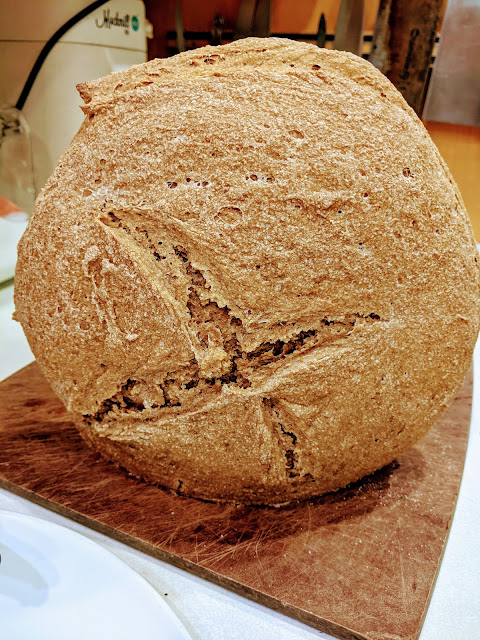
During the Dark Ages, bread was a dietary mainstay. Consuming more calories than it took to stay alive was an everyday endeavor and not always successful. The average lifespan for a male that survived childhood diseases was mid-30s and a female that lived until 30 was a major accomplishment. Bread was made from wheat if you had it and were exceptionally wealthy, but for most everyone else, bread was made of the flour of whatever crops could be harvested: a little wheat, complemented by barley, rye, and in desperate years lentils and acorns. I made this Maslin Bread, maslin means mixed, of barley, rye, and wheat flour all of which I milled myself following a recipe from the Oakden Research Center  in the United Kingdom. Not surprisingly, the bread was somewhere between "dense" and "healthy." It was shockingly tasty, however. There is something about the combination of the three grains that is indeed complimentary and I have enjoyed the bread with every meal of the da...

Sourdough crumpets using leftover sourdough starter

Image
Making sourdough crumpets (or by flipping them over, English Muffins) is surprisingly easy. Using this recipe published by The Washington Post as a base, Susan and I have tried several variations. We have even made some from 100% whole wheat starter. The object of a crumpet is to make it crisp on the bottom side and have lots of holes on the top. When it is eaten still warm from the griddle or direct from a toaster all those holes fill with melting butter and jam. A crisp bottom prevents a mess from pouring through. The recipe is simple enough: 1 cup of mature sourdough starter 2 tsp of sugar (although that makes for an awfully sweet crumpet. 1 - 1.5 tsp of sugar suffices) 1/2 tsp of kosher salt 1/2 tsp baking soda (increasing toward 3/4 tsp of baking soda for a really acid starter created a lot more bubbling action resulting in a crumpet with more holes) Having well oiled crumpet rings are essential for achieving a round shape. Whisk all the ingredients. Pour 1/4 cup of batter into ea...

Miche made with Rye AND Whole Wheat sourdough starters

Image
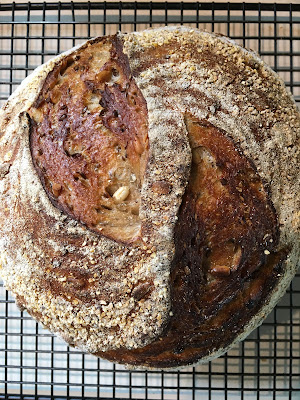
Weaver Street Miche It is not unusual to find a bread recipe that mixes multiple types of flour. In fact, most of my loaves involve at least some combination of white and whole wheat, and often spelt flour. Adjusting ratios of flour, and even when they get mixed with a sourdough starter can make a big difference in the final result. A miche is a hefty loaf with a substantial crust, open crumb, rich earthy colors, rye and wheat flour, and a deep strong range of flavors. I came across this recipe from the Weaver Street Market .  What is unique about Weaver Street's formulation is is its use of both rye starter and wheat starter in the same loaf. Both sourdough cultures are launched the evening before baking and given 16 hours to mature before being kneaded with an additional complement of water, salt, and flour. After a final fermentation, what begins as a rather sticky dough, comes from the oven with boundless character and volume. My miche weighed four pounds. This miche served fiv...

Sourdough Experiments

Image
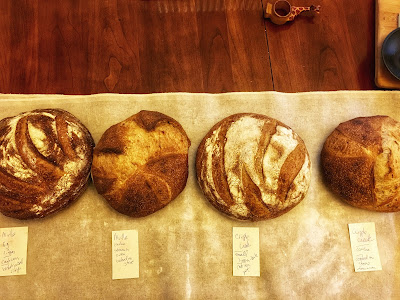
My daughter Leah is an accomplished sourdough baker so when she came to Meadville to visit for a weekend, she and I set up a Breadsperiment. In one weekend we baked eight loaves of bread using two different starters (Meadville and Cripple Creek), two kinds of whole wheat flour (King Arthur vs. freshly milled hard red winter wheat), and two baking methods (steam filled oven vs. covered cast iron dutch oven). We used identical formulas, making every loaf with 50% whole wheat flour (King Arthur or freshly milled) and 50% King Arthur Special Patent white flour. That is Meadville white flour starter on left and Cripple Creek whole wheat starter on the right. Then we held tastings. Day 1 loaves, all made with King Arthur flour. Day 2 loaves made with fresh milled hard red winter wheat, baked in a steamy oven. All four loaves made with freshly milled wheat, oven baked (top), cast iron (below), one side is Meadville starter, the other is Cripple Creek. I have always ...

Slow Rise Sourdough and Refrigeration

Image
A couple of weeks ago I mixed up a dough but did not have time to bake it. This bread had freshly milled, hard spring wheat, sunflower seeds, and flax seeds. I put it in the refrigerator. And left it there for three and a half days. Like a stew or soup that has seasoned with time the flavors that came to life in this loaf were deep, multilayered swells of mellow grains and subtle brews of sourdough flavors. So I tried again. Beginning with my rye starter I added two half-cans of flat Pilsner, coarsely ground corn meal that had soaked overnight, rye, spelt, whole wheat, and white flours. I put it into the refrigerator for 24 hours with the same delectable results. No single flavor prevailed -- after baking the beer was just a faint aroma if you were looking for it -- but the slight crunch of corn, sweetness of rye, and finely milled wheat produced a small sonata.

Sourdough Flat Breads with Ramps

Image
Now that I have a mill with which to grind fresh, whole-grain flour, my first stage is grinding. Because spring is finally approaching Meadville, Pennsylvania, this week's delivery of our CSA vegetables included freshly picked ramps. A couple of years ago I found David Lebovitz's recipe for scallion flatbreads and I thought that exchanging green onions for the garlicky flavor of chopped ramps would not be a very radical substitution. Once the sourdough did its thing, I gently kneaded in chopped ringlets from the bulbous end of the ramps and fried the flatbreads. We served the breads with salad, beer, and some beef ribs that had been in the freezer since Marty cooked them for the December holidays. The meal was extravagant but could not have been easier to prepare: mix together a salad, thaw and warm the ribs, flatten and fry the breads, and pour the beer.

Baking Multiple Kinds of Breads at Once

Image
The tools of the trade were all on deck Saturday when I was making three kinds of bread at once. Left to right in the front row are a bowl of starter with recently added flour, a recently mixed bowl of rye starter (Danish dough whisk still present), the smooth caramel top of a whole wheat, spelt bread on its final rise, a small bowl of freshly milled rye flour, and a mason jar of rye sourdough starter. In the middle row are two jars and a bag of whole grains. In the back are more flours and second from right my grain mill. Making three kinds of bread requires the additional skill of tracking. Each dough, of course, requires different ingredients, but they have to be kneaded differently, raised for different lengths of time, stretched and folded at varying intervals over 24 - 36 hours, baked at different temperatures and put into the oven when they are ready. Knowing when to bake a sourdough bread depends a whole lot more on experience than it does for a yeast bread. One reason dis...