Posts

Showing posts with the label Non fiction

Plunder by Menachem Kaiser *** (of 4)

Image
  The author's grandfather was the only member of his Polish family to survive the Nazi's death camps. Grandpa died before the author was born, but according to the author's father, after the war ended, the grandfather spent 20 unsuccessful years tilting against Polish and German bureaucracies in an attempt to reclaim his apartment building in Sosniewicz, Poland.  Menachem Kaiser reengages the struggle for restitution in part to see if he can find an attachment to the grandfather he never met. With a jaundiced eye at other so-called Holocaust tourists - Jewish descendants just like himself searching for some abstract kind of connection to lost family or closure - Kaiser learns the building is worth $400 and cannot fathom why his grandfather suffered such anguish to get it back.  What makes the book interesting is Kaiser's musings on the nature of homelands, the meaning of forcible loss of property, and then as he gets closer to potential acquisition of his grandfather...

The Undoing Project by Michael Lewis *** (of 4)

Image
Amos Tversky and Danny Kahnemann, were a pair of exceptionally brilliant Israeli thinkers, who forged a friendship and academic partnership that led to the invention of behavioral economics and a Nobel Prize. Before the pair started questioning, and then testing, centuries-old dogma about economic behavior, the fundamental assumption by economists was that all humans acted out of self interest. People maximized gain, prioritized happiness, avoided pain, weighed benefits against costs, and made decisions with the best odds for the most advantage. Only, Tversky and Kahneman when they gave people a variety of choices whose outcomes were mathematically proven to have a better and worse outcome, discovered that a surprising number of people made the wrong decision. Not just ordinary people made mistakes; even statisticians with PhDs who should have known better could be induced to select a path that was demonstrably worse than a clearly correct answer. For example, a terminally ill patient ...

Vesper Flights by Helen Macdonald **** (of 4)

Image
This is an excellent bedtime book. It contains a compilation of short essays about human nature, the nature of animals, the myriad interaction of humans and animals in domestic and wild spaces, and simply nature. You can read one story at a time, be fully transported to a new location, be introduced to a bird, birder, goat, boyfriend, parent, flock, or sunset and you will see each one with new eyes, because in addition to being an exceptional writer, Helen Macdonald is also an extraordinary seer.  What she makes clear to us is the visceral loss accompanying the Sixth Extinction, the rapid, on-going, seemingly unstoppable disappearance of species diminished by human planetary dominance. Yes, depressing, but also a crystal-clear, heart pounding view of the world around us that so few of us take the time to observe, carefully. Even within a few pages Macdonald can make you think about the connection between migraine headaches and climate change, the power, for better and worse, of reh...

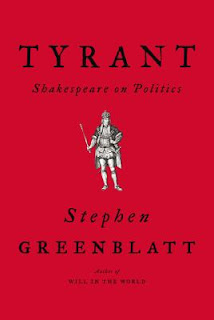
Tyrant by Stephen Greenblatt ** ( of 4)

Image
Not once does Stephen Greenblatt or William Shakespeare mention Donald Trump by name but it is obvious from page one that at least one of the authors has Trump on the brain and the other predicted him 500 years ago. What Greenblatt does best is make it painfully clear that tyrants of all ages and locations bear many of the same character traits: insecurity, bullying, toady advisors to whom they have no special allegiance, narcissism, abusive relationships with women, and an absence of empathy. Shakespeare's tyrants like Richard II, Macbeth, Julius Caesar, and King Lear seen through a Trumpian lens are sadly familiar. Their adherents are the same group of people either willingly hoodwinked out of desperation for their personal plights or self-serving jerks who think they can ride the tyrant's coattails for personal gain. It is in some ways encouraging to recognize that Trump is not unique to America or our era: his type has been around since the beginning of power struggles. The...

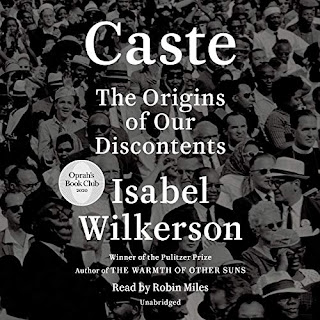
Caste by Isabel Wilkerson **** (of 4)

Image
  In 1932, when Nazi planners were devising a plan that would lead to the marginalization, denigration, disenfranchisement, and eventual elimination of its Jewish citizens, they modeled their efforts on how America marked its black citizens in such a way that they could not be full members of American society. Nearly 70 years after slavery was outlawed, Black Americans could not attend white schools, eat in white restaurants, drink from white water fountains, swim in white pools, live in white neighborhoods, walk on a sidewalk if a white was approaching, or speak back to a white person in any way other than deferential. Failure to adhere to the rules of American white superiority could result in summary execution by mobs of self-appointed upholders of white law. More than 4,000 blacks were lynched. American segregation was the perfect model for Nazism and somehow I never learned that in school. What Caste  makes clear is that race, or more accurately, skin color was an arbitra...

Surrender White People by D.L. Hughley *** (of 4)

Image
It is interesting that so many books on the market about white supremacy and racism were published long before the murder of George Floyd finally got white people to stop and pay attention. Surrender, White People!  was published post-Floyd, but written before, just one more confirmation that a book about the mistreatment of Black Americans by white Americans would continue to be prescient. Hughley's approach to trying to get white people to understand is to describe life for Blacks as if it were funny. The book is short, but encyclopedic in its coverage, covering topics that everyone should know. Blacks have been denied access to fair housing for generations. Health care and food access for Blacks is of poorer quality than it is for whites. Schools for Black children are more crowded and less well funded. Air pollution and leaded water systems are more prevalent in Black neighborhoods. Jobs, salaries, incarceration rates, arrests and so forth generate worse outcomes for Blacks tha...

The Enemy of All Mankind by Steven Johnson ** (of 4)

Image
Most book reviewers loved Enemy , but I think it is terribly overrated. In the 17th century, Henry Every, a British pirate, stole a fast-sailing ship from the Spanish coast, sailed it to India, and attacked an exceptionally well-endowed vessel belonging to one of India's wealthiest Mughals. His crew, after a year at sea, upon discovering women on board, did some evil things to them. Johnson does a decent job of laying context. The distinction between being a pirate and a British privateer was rather fuzzy so in Johnson's telling, acting as a pirate might not have been such a bad job, after all, especially at a time when the British government was capturing young men to "impress" them into their Navy. The British Navy, too, was in the business of protecting Great Britain's colonies, which, if you look at them with modern eyes, were nothing more than piratical extractions of resources from stationary targets.  But Johnson expends way too many words inflating the das...

The Unlikely Disciple by Kevin Roose *** (of 4)

Image
It was a great idea (especially in 2010), pulled off with panache. The author, Kevin Roose, took a leave of absence from Brown University in the second semester of his freshman year. Instead of studying abroad with other Americans in Madrid or Paris, Roose enrolled at Liberty University, America's flagship school for evangelicals, thus moving from one of the most liberal to one of the most conservative universities in the United States. Most of what Roose describes would not be a surprise to anyone following Jerry Falwell's political agenda. If you are not so familiar, then this book is a good introduction to a university that insists that no liberal views are permitted on its campus. Students "learn" that evolution never happened and the earth is only 6,000 years old. Abortion is murder. All homosexuals are faggots. Women should marry early, support their husbands, and bear many children. Prayer is infallible. Muslims are infidels. Also, not very surprising, Roose di...

Why Fish Don't Exist by Lulu Miller **** ( of 4)

Image
David Starr Jordan was obsessed with making order from the chaos of nature. At the turn toward the 20th century, and importantly not so long after Charles Darwin's publication of The Origin of Species , Jordan set out to name and place within a taxonomic category every fish he could capture from planet earth. A wife and child died early in his life and yet he persevered with such fortitude and public success he rose to become President of Stanford University. Adversity and chaos continue to track Jordan when among other calamities the San Francisco earthquake of 1906 destroyed thousands of his specimen jars, displacing archetypal samples from their floating labels in a shower of broken glass and formaldehyde. Within hours, Jordan was sewing labels to the gills of fish he could still identify, picking himself up and restarting his mission. Lulu Miller, whose own life has been overtaken by chaos and disorder, finds herself obsessed with David Starr Jordan, hoping that in understandin...

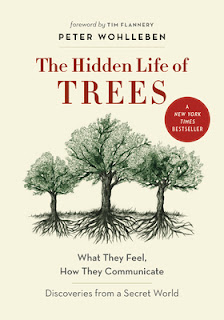
The Hidden Life of Trees by Peter Wohlleben *** (of 4)

Image
Peter Wohlleben is either way ahead of his time or a flake. His hypothesis from page one forward is that trees are like people, except when they are superior: they live longer and are stronger than humans, for instance. He makes his case by translating recent scientific discoveries about tree ecology and biochemistry into human analogies like smell, fear, pain, compassion, and anxiety. So, for example, an acacia forest being nibbled by giraffes will release chemicals into the atmosphere that downwind acacias recognize. The receiving acacias produce chemicals in their leaves that make them less tasty to other giraffes. Wohlleben calls that speech and smell. Older trees in German forests can share nutrients with younger trees. It is an easy enough experiment to run. Traceable radioactive isotopes introduced into old trees appear in the stems and foliage of younger trees after they have traveled down the trunk, through an interconnected root system, and upward into the new stem. Wohlleben...

Say Nothing by Patrick Radden Keefe **** (of 4)

Image
The decades long civil war in Northern Ireland, like all civil wars, was vicious, and for outsiders, difficult to comprehend. Patrick Radden Keefe's take on The Troubles, as they were known, is to put the lives of four important players under a microscope. Gerry Adams, Brendan Hughes, and Dolours Price were leaders in the Catholic uprising by the Irish Republican Army. Together, when they were not in jail, they spent much of the 1970s and 1980s attempting to dislodge Protestants and the British military from northern Ireland. The fourth, Jean McConville, mother of ten children, and perhaps a spy abetting the British government in tracking down members of the IRA, was kidnapped and murdered during the height of The Troubles. In a well-told story (listen to the audiobook, if at all possible), an interminable war of attrition grinds on and as is so often the case in civil wars (the Arab-Israel conflict, Hutus and Tutsis in Rwanda, Lebanon, Syria, Yemen, Somalia, Sudan) is built upon e...

Me and White Supremacy by Layla Saad **** (of 4)

Image
What makes me and white supremacy  so effective is it ample accessibility. The book's origin was originally a 28-day instagram challenge. Layla Saad followed with a workbook and then finally this book. There are, with a few bracketing sections, still 28 short chapters. Each chapter is followed with questions designed to stimulate journaling and deep self-reflection. The center of each chapter contains clearly explained bullet points on topics such as white saviorism, white fragility, tone policing, white privelege, and well, another 24 topics we all must address. Saad says at the beginning, and repeats: white supremacy is ubiquitous, systemic, pervasive, largely invisible to white people, and terribly difficult to acknowledge and do something about. She also makes clear that failure to do so, i.e., business as usual, is profoundly denigrating and deadly to BIPOC (Black and Indigenous People of Color.) It is no small feat to get people to read a book that promises to make them feel ...

Midnight in Chernobyl *** (of 4)

Image
Chernyobyl has entered the global lexicon as a stand-in for the planet's most devastating public nuclear disaster. The USSR was deep in the throes of a Cold War competition for global supremacy in science, technology, politics, power, and armaments, but built upon an impossible economic model. Compounding its economic failures to produce what Soviets actually needed in the quantities they needed them was a historical system of politics that relied upon sycophancy, falsification, and placation of superiors. The result was the construction of a nuclear power plant with serious design flaws because underlings were loathe to report errors to superiors. Combine a faulty power plant, a government hellbent on proving its nuclear mettle on the global stage, and the inevitability of a combination of tiny, impossible to imagine human errors and the suspense of Chernobyl is laid bare. When the explosion of Reactor 4 finally occurred in October 1986, the scale of the explosion was so unpredict...

Blowout by Rachel Maddow **** (of 4)

Image
Since its earliest commercial success in Drakes Well, Pennsylvania, just 30 miles from where I live, the oil and gas industry has created enormous wealth and in its wake, environmental havoc and maldistribution of power. The "Oil Curse," well known to economists, is the process by which the export of oil and gas is traded for the import of petro-dollars which nearly always end up in corruption rather than development. Blowout  begins with a blatant case of big money going bad. Equatorial Guinea, for example, has exported such vast quantities of oil that its megalomaniacal autocratic leaders have enriched themselves beyond anyone's wildest ability to fathom. And yet, over the course of several decades of profligacy by the royal family, every measure of human development in Equatorial Guinea has fallen. Education, literacy rates, individual income, availability of drinking water, and health care have all declined. Oil spills and contaminated ecosystems abound. Case number t...

A Good Provider is One Who Leaves by Jason DeParle **** (of 4)

Image
What irony to finish a book about families that leave their homes, spouses, relatives, languages, foods, and often their children for the dream of coming to America on the same day that the President of the United States signed an executive order forbidding any foreigners (except important laborers supported by business interests) from crossing our borders. Jason DeParle personalizes global migration by following three generations of a Philippino family he has lived with and befriended for more than 30 years. No country has adopted the export of its citizens with more national zeal and national policy than the Philippines, supplying many of the world's nurses, ship hands, and laborers, both skilled and unskilled. The remittances of emigres fuel the Philippine economy. But that is macro economics. Micro economics becomes painful as DeParle follows his friends as they battle homesickness and isolation in order to make enough money to lift families from shanty-dwelling poverty....

Black Tulip by Erik Schmidt *** (of 4)

Image
Sometimes, examination of a microscopic detail can illustrate a much larger image. Such is the case in this thoroughly researched biography of Erich Hartmann, the WW II pilot with the greatest number of kills. Hartmann dispatched more than 300 enemy airplanes while flying missions for Germany's Luftwaffe, more than double the war's next most successful pilot, and in general terms, ten times as many as an average pilot flying for any country during the war. Hartmann's unchallenged ability to knock an airplane out of the sky depended upon incredible close-flying skill, devastating sneak attacks, point-blank firing, and rapid escape to avoid hurtling shrapnel. Hagiographers on both sides of the Atlantic have elevated Hartmann to idol status in the subsequent decades; a dueling knight of chivalry and honor. Which is why Schmidt's detailed analysis is so timely and important. Hartmann, after all, was flying in support of Hitler's offensives on the Western Front, t...

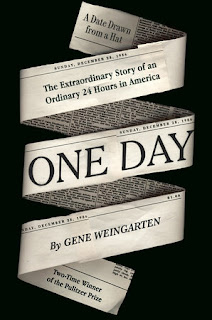
One Day by Gene Weingarten **** (of 4)

Image
On a challenge, Gene Weingarten wrote a book about December 28, 1986, a Sunday in America picked at random. Think of all the newspapers in the country and what might have made the cut back in the day and it is pretty much what you'd expect: fires, murders, sports, car crashes, arrests, celebrations, and the arts, though not a lot of arts as the selected date fell in the quiet week between Christmas and the New Year. In the hands of twice-awarded Pulitzer Prize author, story after story unfolds to reveal the full depth of the American experience. A burning house, when fully investigated, includes the life-altering reactions of fire-fighters, children caught in the blaze, and parents whose trajectories from birth to that cataclysmic moment are far more complex than they are described in a newspaper column. Those swoops and arcs, measured as snapshots on December 28, are carried through the next 25 years with contemporary interviews. A football playoff game, similarly covered i...

Furious Hours by Casey Cep *** (of 4)

Image
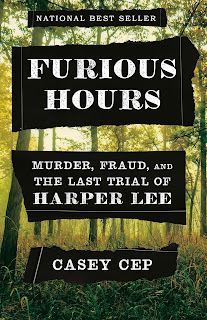
Three mysteries. In the first, the Reverend Willie Maxwell, a black Alabama preacher, was tied to the deaths of five close family members, including a couple of wives. Following each untimely departure, the Reverend was the primary beneficiary on several life insurance policies per deceased. While all of the investigations strongly suggested murder for profit, Tom Radney, a civil rights lawyer, and unsuccessful liberal politician, managed acquittals in every trial. At the funeral of Willie Maxwell's third wife's daughter, the Reverend was shot dead by Robert Burns. There was no question about who killed Maxwell. The church was packed. Everyone saw Burns fire three shots. Nor was there much question about why -- Burns had had enough of Maxwell's antics -- so the second mystery was only whether Burns would be convicted. Tom Radney, the same lawyer that defended Maxwell, now successfully defended  Burns, who was acquitted on grounds of insanity and released from psychiatr...

On Desperate Ground by Hampton Sides **** (of 4)

Image
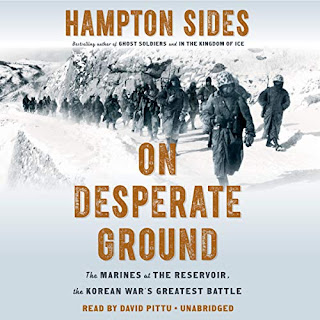
In 1950, the Cold War between communists in the Soviet Union and communist-fearing Americans led by the likes of Senator Joseph McCarthy was feverish. President Truman -- as all Presidents must -- was attending to domestic crises when North Korean communists invaded the southern half of the country. General Douglas MacArthur, a man of Trumpian self-assurance, insisted the communists could be demolished in the background while MacArthur posed for press photos in the foreground. Edward Almond, Commander of the U.S. Marine X Corps was a MacArthur sycophant who directed the marines to push the North Koreans out of the south. Mission complete, he ordered the marines to continue their march to the Yalu River on the Chinese border. General MacArthur posing during the invasion of Inchon On Desperate Ground  manages to paint a picture that remains in focus when seen from spy sattelite and when magnified to individual marines trapped along the Chosin Reservoir. X Corps was surrounded...

The Color of Love by Marra B. Gad *** (of 4)

Image
Marra B. Gad was born of a Jewish mother and African American father and adopted at birth by a Reform Jewish family in Chicago. Her new family loved her to pieces and she was raised in Reform Jewish tradition, which is to say Hebrew School, camp, Bat Mitzvah, and an ample supply of desserts. Only Marra's skin is black and many aunts, uncles, and cousins treated her with thinly disguised, racist contempt. Most blatant of all was Marra's great aunt Nette whose love and approval Marra coveted. Nette finally says aloud what has been obvious for decades, "Nothing is worse than being black." And yet in a triumph of human spirit and fundamental teachings of Judaism to provide succor to the unwell and aging, Marra serves as Nette's primary care giver as Nette succumbs to Alzheimer's. The Color of Love  reminds us that we are all made of multiple pieces -- religion, age, temperament, weight, nationality, sex, gender -- and that skin color, like the size of our e...