Posts

Showing posts with the label 4-stars

Burn the Place by Iliana Regan **** (of 4)

Image
 Place this book in the category of Who-like cries ( Horton Hears a Who,  Dr. Seuss) from fly-over country: "We are here. We are here." Like Tara Westover's Educated  and J.D. Vance's Hillbilly Elegy , Regan's Burn the Place  is a coming of age story for an alcoholic child of a dysfunctional family. And like Westover and Vance, she succeeds against odds that seem unfairly stacked against her: untreated mental health issues, growing up lesbian (and perhaps trans) in religious, rural Indiana, discordant parents, and excessive self-medication with drugs, alcohol, and sex.  Regan's recounting of childhood, puberty, and early adulthood are presented with bare-faced honesty and without polish. Burn the Place  is not crafted as a morality tale like other books of the genre. Rather, pluck and luck seem to be Regan's saving graces. She might just have easily ended up dead in a drunken car crash. Instead of dying, she hones a life based on an intrinsic understanding...
The Lost Man by Jane Harper **** (of 4)

Image
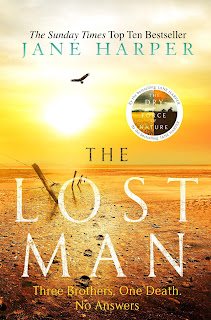
The protagonist of The Lost Man  is Nathan Bright, the oldest of three brothers. Nathan lives alone tending  cattle on a marginal farm in the Australian outback whose dimensions are so large that it takes hours and hours of driving dusty dirt roads to go end to end. The main character, however, is the outback itself. Hundreds of thousand of acres of near-desert flatness, summer daytime temperatures beyond human capacities, and unparalleled nighttime darkness.  Somewhere midway between Nathan's farm and one managed by his middle brother, Cameron, is the mythical stockman's grave. The book opens when the youngest brother, Bub, and Nathan meet at the grave where Cameron has just died of heat and dehydration, something an experienced farmer like Cameron would not have fallen prey to accidentally. Moving at the slow pace of a rising summer sun, but with the inescapable intensity of midday in the desert, the secret lives of the three brothers, their wives, and children emerge f...

Why Fish Don't Exist by Lulu Miller **** ( of 4)

Image
David Starr Jordan was obsessed with making order from the chaos of nature. At the turn toward the 20th century, and importantly not so long after Charles Darwin's publication of The Origin of Species , Jordan set out to name and place within a taxonomic category every fish he could capture from planet earth. A wife and child died early in his life and yet he persevered with such fortitude and public success he rose to become President of Stanford University. Adversity and chaos continue to track Jordan when among other calamities the San Francisco earthquake of 1906 destroyed thousands of his specimen jars, displacing archetypal samples from their floating labels in a shower of broken glass and formaldehyde. Within hours, Jordan was sewing labels to the gills of fish he could still identify, picking himself up and restarting his mission. Lulu Miller, whose own life has been overtaken by chaos and disorder, finds herself obsessed with David Starr Jordan, hoping that in understandin...

Say Nothing by Patrick Radden Keefe **** (of 4)

Image
The decades long civil war in Northern Ireland, like all civil wars, was vicious, and for outsiders, difficult to comprehend. Patrick Radden Keefe's take on The Troubles, as they were known, is to put the lives of four important players under a microscope. Gerry Adams, Brendan Hughes, and Dolours Price were leaders in the Catholic uprising by the Irish Republican Army. Together, when they were not in jail, they spent much of the 1970s and 1980s attempting to dislodge Protestants and the British military from northern Ireland. The fourth, Jean McConville, mother of ten children, and perhaps a spy abetting the British government in tracking down members of the IRA, was kidnapped and murdered during the height of The Troubles. In a well-told story (listen to the audiobook, if at all possible), an interminable war of attrition grinds on and as is so often the case in civil wars (the Arab-Israel conflict, Hutus and Tutsis in Rwanda, Lebanon, Syria, Yemen, Somalia, Sudan) is built upon e...

Me and White Supremacy by Layla Saad **** (of 4)

Image
What makes me and white supremacy  so effective is it ample accessibility. The book's origin was originally a 28-day instagram challenge. Layla Saad followed with a workbook and then finally this book. There are, with a few bracketing sections, still 28 short chapters. Each chapter is followed with questions designed to stimulate journaling and deep self-reflection. The center of each chapter contains clearly explained bullet points on topics such as white saviorism, white fragility, tone policing, white privelege, and well, another 24 topics we all must address. Saad says at the beginning, and repeats: white supremacy is ubiquitous, systemic, pervasive, largely invisible to white people, and terribly difficult to acknowledge and do something about. She also makes clear that failure to do so, i.e., business as usual, is profoundly denigrating and deadly to BIPOC (Black and Indigenous People of Color.) It is no small feat to get people to read a book that promises to make them feel ...

Transcription by Kate Atkinson **** (of 4)

Image
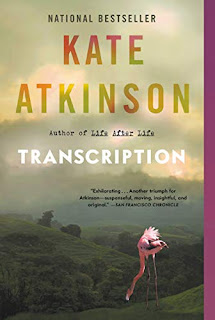
Juliet Armstrong, orphaned at the age of 17 just as Hitler's Germany is rolling across Europe, is scooped up by MI5. Her job is to serve as a typist, a role, of course, only a girl can fill. MI5 occupies two adjoining rooms in a small apartment complex in London. In one, Godfried Toby, an MI5 agent meets British citizens sympathetic, and perhaps outright allies, of the Third Reich. Listening devices are implanted in the walls and voices are recorded  in the adjacent apartment for Juliet to transcribe.  With time Juliet is asked to infiltrate the Fifth Column of British fascists under disguise and with additional time, actually five years after the war ends, Juliet is still enmeshed in spy work, only now ferrying eastern bloc scientists to the west and plying communist sympathizers with false information. Or maybe it is top secret information. Or maybe her handlers were always communist sympathizers. Or maybe Godfried Toby works for no one. Or anyone.  Being employed ...

Cannery Row by John Steinbeck **** (of 4)

Image
Steinbeck uses Cannery Row to tell a long yarn about a community of hobos, prostitutes, semi-homeless, store owners, and an amateur marine biologist living adjacent to some Pacific sardine-canning factories. The era is the Great Depression, the ocean and its tide pools are described in minute detail, and Cannery Row's inhabitants receive the same respect, dignity, and more than a little love. Lee Chong runs an all-purpose store where patrons can purchase everything from eggs and butter to firecrackers and hardware. Most people buy beer or whiskey they use to become pleasantly drunk. They pay with scrip or credit, and on one significant occasion, with several hundred recently captured frogs. Doc, the biologist, collects sea creatures for scientific labs, has an open-door, and takes a troubled youth, too slow to learn in school, under his wing.  Mack and his four work-avoiding buddies reside in an abandoned warehouse, affectionately known as the Palace Flophouse, where they spend nea...

Blowout by Rachel Maddow **** (of 4)

Image
Since its earliest commercial success in Drakes Well, Pennsylvania, just 30 miles from where I live, the oil and gas industry has created enormous wealth and in its wake, environmental havoc and maldistribution of power. The "Oil Curse," well known to economists, is the process by which the export of oil and gas is traded for the import of petro-dollars which nearly always end up in corruption rather than development. Blowout  begins with a blatant case of big money going bad. Equatorial Guinea, for example, has exported such vast quantities of oil that its megalomaniacal autocratic leaders have enriched themselves beyond anyone's wildest ability to fathom. And yet, over the course of several decades of profligacy by the royal family, every measure of human development in Equatorial Guinea has fallen. Education, literacy rates, individual income, availability of drinking water, and health care have all declined. Oil spills and contaminated ecosystems abound. Case number t...

The Lost Girls of Paris by Pam Jenoff **** (of 4)

Image
In June 1940 Winston Churchill ordered the creation of Special Operations Executive (SOE) for the purpose of sabotaging Nazi operations in occupied portions of France. Among SOE's operatives were Britain's first women in combat. The Lost Girls of Paris  describes the wartime lives of some of these women from their first days as young recruits, through their training, and finally to their secret missions in occupied France. Violette Szabo ,  re-created in  The Lost Girls of Paris  as Marie,  was a British citizen, who as a single mother of a toddler, agreed to parachute into France. Violette Szabo recovering from an ankle injury suffered during parachute training, 1944.  Marie, like Violette, operated a secret radio transmitter under the noses of the Nazis and assisted in blowing up a bridge that would have been vital to German forces responding to the imminent D-Day invasion. What Pam Jenoff does so well is capture the danger, tension, isolation, br...

A Good Provider is One Who Leaves by Jason DeParle **** (of 4)

Image
What irony to finish a book about families that leave their homes, spouses, relatives, languages, foods, and often their children for the dream of coming to America on the same day that the President of the United States signed an executive order forbidding any foreigners (except important laborers supported by business interests) from crossing our borders. Jason DeParle personalizes global migration by following three generations of a Philippino family he has lived with and befriended for more than 30 years. No country has adopted the export of its citizens with more national zeal and national policy than the Philippines, supplying many of the world's nurses, ship hands, and laborers, both skilled and unskilled. The remittances of emigres fuel the Philippine economy. But that is macro economics. Micro economics becomes painful as DeParle follows his friends as they battle homesickness and isolation in order to make enough money to lift families from shanty-dwelling poverty....

On Desperate Ground by Hampton Sides **** (of 4)

Image
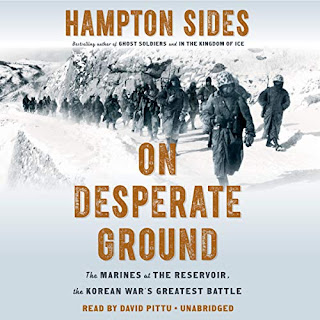
In 1950, the Cold War between communists in the Soviet Union and communist-fearing Americans led by the likes of Senator Joseph McCarthy was feverish. President Truman -- as all Presidents must -- was attending to domestic crises when North Korean communists invaded the southern half of the country. General Douglas MacArthur, a man of Trumpian self-assurance, insisted the communists could be demolished in the background while MacArthur posed for press photos in the foreground. Edward Almond, Commander of the U.S. Marine X Corps was a MacArthur sycophant who directed the marines to push the North Koreans out of the south. Mission complete, he ordered the marines to continue their march to the Yalu River on the Chinese border. General MacArthur posing during the invasion of Inchon On Desperate Ground  manages to paint a picture that remains in focus when seen from spy sattelite and when magnified to individual marines trapped along the Chosin Reservoir. X Corps was surrounded...

Exit West by Mohsin Hamid **** (of 4)

Image
Saeed and Nadia live in an unnamed, but all too familiar, Middle Eastern city where government forces are slowly losing the battle to Islamic militants. The young couple meet in college, before it closes, when  Saeed finally finds the courage to ask Nadia out for coffee on a Friday. When Nadia asks him why he isn't going to be praying, Saeed has to stumble for an answer. Later, when Saeed asks Nadia why she remains fully covered in traditional robes even though she is not religious, Nadia replies, "So men don't fuck with me." What follows is a courtship interspersed with car bombings, government reprisals in the form of long-distance shelling and air raids, and neighborhood by neighborhood success of young combatants drunk on power as the government slowly loses control of its country. Escape from the city is condensed: an enormous sum of money is handed to a trafficker who might steal the money or actually provide safe passage. In Exit West , transport is acco...

Normal People by Sally Rooney **** (of 4)

Image
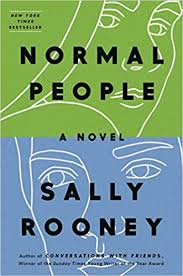
In the small town of Carricklea, Ireland, Connell is the lone high school son of a single mom, Lorraine. Lorraine cleans house for Marianne's upper-crust, and as we are going to discover, dysfunctional family. Marianne and Connell are high school classmates, best friends, and so intellectual that their relationships with their high school classmates are tenuous. They are also on-again, off-again lovers and sexual partners swimming their way upstream against the currents of peer pressure, economic class distinctions -- real, imagined, and magnified in British society -- damaged childhoods, impending adulthood, and university attendance in Dublin. Admittedly, my plot and character descriptions sound mundane, but Rooney's development of Connell's and Marianne's relationships to one another and to maturation is so microscopically accurate that their every failure is a painful reminder of our own, and their successes generate unbridled celebration. Normal People  is S...

Professor Chandra Follows His Bliss by Rajeev Balasubramanyam **** (of 5)

Image
Professor Chandra was born in India and almost lived up to his parent's expectations for success. Now, approaching his 70th birthday he is a distinguished, and hilariously pompous, professor of economics at Cambridge University. This might even be the year he wins a Nobel in economics so he practices his nonchalance and indifference in preparation for meeting the King of Sweden. Not only does Professor Chandra fail to win again this year, but now that he has been run over by a student on a bicycle while he absentmindedly crossed the street without looking, he has time to recognize that one daughter stopped speaking with him two years ago, another daughter is not going to college (a blasphemy!), and his son has moved to Hong Kong and barely has time to call. Not that Chandra has really mastered his cell phone, anyway. On a visit to his ex-wife and her husband in Colorado, Professor Chandra is persuaded, rather forcefully, to attend the Esalen Institute in California setting u...

The 100 Most Jewish Foods edited by Alana Newhouse **** (of 4)

Image
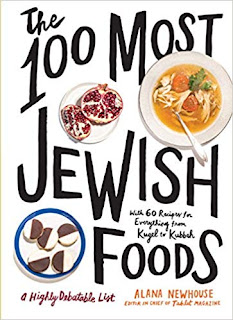
Admittedly, any book with an image of black and white cookies on its cover is going to grab my interest. This book about Jewish foods traditional to Ashkenazim of Eastern Europe, early 20th century immigrants to New York City, North African Sephardim, and foods the editor suggests should be traditional are included. Each item receives about a page of description and 60 of the 100 are accompanied by recipes. As both the subtitle and introduction make clear, the  100 Most Jewish Foods is highly debatable. Chicken soup, matzoh balls, tsimmes, bagels are all obvious, but every reader can only imagine how many impassioned discussions took place before Entenmann's made the book, but Fruit Cocktail did not. Pickles, lox, brisket, tuna fish, and margarine made the cut, but not Cool Whip or Cel-Ray. And Oy, the arguments that must have ensued over recipes? How many different recipes for chicken soup do you think could be gathered from a roomful of Jewish mothers? Which one to includ...

All Who Go Do Not Return by Shulem Deen **** (of 4)

Image
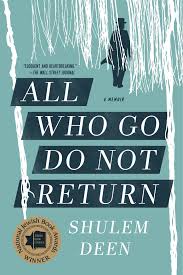
For far too many centuries mainstream Judaism mired in ritual and stagnant orthodoxy. Just as the darkness of the Middle Ages was brightening, a new group of rabbis anxious to revive a moribund religion infused joy, song, dance, and the mystical into daily services. The irony is that Hasidic practice then lithified in the 18th and 19th centuries becoming so restrictive and formulaic that sects of Hasidim today are in many ways indistinguishable from religious fundamentalists of any stripe. The Seret-Vishnitzer rebbe, center. Hasids must adhere to ultra-strict, not just Kosher, dietary rules. Men are separated from women as neither sex may look upon the other outside of marriage. Sexual relations are prescribed with regard time of day, frequency and purpose: procreation. Dress codes may not change from what they were in 1800 eastern Europe. Even English is frowned upon in favor of Yiddish, Hasidism's lingua franca. Schooling for boys is restricted to Torah study. Women are r...

Leonardo da Vinci by Walter Isaacson **** (of 4)

Image
Leonardo painted the two most famous paintings in the world: The Last Supper and the Mona Lisa, but I think what I have always found so fascinating about Leonardo is his breadth of genius. Leonardo designed ideal cities, studied optics, advanced the world of anatomy (by dissecting scores of cadavers, human and animal), accurately explained why the moon shines and why you can see portions of the moon that are not lit beyond its crescent, drew up plans to divert rivers, created entertaining court spectacles with flying machines and realistic dragons, planned military devices such as armored tanks, chariots with scythe-bearing wheels, and massive cross-bows, figured out why the sky is blue, how beams of light refract as they enter the eye and how to use that information to create paintings that would look real when viewed from any angle. He engaged in architecture, geometry, urban planning, civil engineering, sculpture, geology, and in many ways presaged the invention of science at a...

The House of Broken Angels by Luis Alberto Urrea **** (of 5)

Image
From the moment Luis Alberto Urrea begins reading his novel (I recommend the audio book) in Mexican-American Espanglish every character in this huge family jumps to life. Big Angel, the family patriarch is dying of cancer, but instead of becoming morose, he passes his days recounting the joys of his life: working, his wife's skinny legs in stockings, oysters, his family. After attending his mother's funeral, and arriving frustratingly late ( Real Mexicans are not late!, he bellows ), he readies himself for his own birthday fiesta. Brothers, children, Tios and Tias , grandchildren too numerous to count, girlfriends and boyfriends in every generation, mariachi bands, folding tables bearing too much food, and a decorated cake from El Target arrive bringing with them family conflicts, simmering alienation, and the committed love of four generations. 

Barbarian Days by William Finnegan **** (of 4)

Image
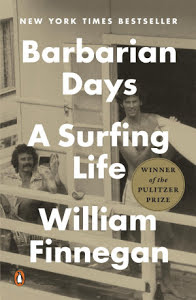
You need not have ever surfed nor even cared about the ocean to be swept away by the glorious writing of Barbarian Days . I'm guessing that William Finnegan describes more than five hundred waves in this book without using the same terms twice. Every wave is distinct and therein lies Finnegan's definition of a life well-lived. Here is one example from page 356 about waves in Madeira, an island off the coast of Portugal.  "Heavy, long-interval lines marched out of the west, bending around the headland into a breathtaking curve. They feathered and bowled and broke at the outermost point of the horseshoe, and then reeled down a rocky shore...As we got closer to the lineup, the power and beauty of the waves got more drenching. A set rolled through, shining and roaring in the low winter afternoon sun, and my throat clogged with emotion -- some nameless mess of joy, fear, love, lust, gratitude." Finnegan is a lifelong reporter for The New Yorker and could have writte...

Washington Black by Esi Edugyan **** (of 4)

Image
As a young boy Washington Black was enslaved in Barbados. Faith Plantation treated its slaves like the machines that they were: fueling, watering, greasing, beating, and running until their parts failed and their bodies were disposed of to be replaced by new purchases. One of the sons of the plantation owners, Titch, is something of an early British explorer, however, who constructs a "cloud-cutter," a helium-filled balloon that happens to need ballast of just Washington's size. For enslaved Africans, the gift of flight, like the gift of death, was one means to dream of escape. Check out this video from The New Yorker (March 6, 2019) called Dreaming Gave us Wings . Cane-cutters in Jamaica , post slavery.  By the time Titch and Washington Black launch their balloon, this novel has also taken off into new territory. Washington Black, even as a young teen, is the most erudite British gentleman I have ever met in literature; he is also an accomplished artist and scien...