Posts

Showing posts with the label Great Britain

The Thursday Murder Club by Richard Osman *** (of 4)

Image
  Richard Osman gets credit for inventing a new detective, in this case, a crew of detectives. In addition to a pair of peripheral police officers in a small town outside London, the primary investigators into a series of murders are four residents of a senior living center. They suffer from mobility issues. They pay undue attention to who sits with whom in the dining room. They drink wine while pretending to work on jigsaw puzzles and they tell stories in the long-winded, gossipy way of old people. But they haven't lost their mental acuity. At least not yet. The Thursday Murder Club is comprised of two widowers (Ron, whose son at least still visits from time to time, and Ibrahim), a widow (Joyce, who maintains a keen eye for newly arrived single men) and Elisabeth, whose husband is rapidly disappearing into the ravages of dementia. They gather in the jigsaw room - before Zumba - every Thursday to try to solve old cases left in files by one of their founding members, Penny, a forme...
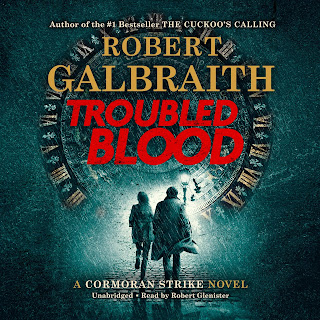
Troubled Blood by J.K. Rowling (Robert Galbraith) *** (of 4)

Image
  Fifth in the JK Rowling series of crime novels in which private detective Cormoran Strike and now-profesional-partner Robin Ellacott get paid to investigate crimes. Naturally, they receive a lot of requests to track down philandering husbands and business partners suspected of skimming the books, but also once per book they also have to cope with someone truly despicable and dangerous. Troubled Blood  is a request from the daughter of a mother that went missing decades ago. At the time of the incident the disappearance was pinned on a pathological serial killer, but the evidence was shaky and the investigating policeman was losing his mind. Rowling is a master of multiple storylines: we find ourselves tied up in more than a search for a presumed killer. We want to know whether Cormoran and Robin can keep their relationship strictly professional and how each will grow following losses in their personal lives. It matters how the two of them relate to their parents, struggling ...

Vesper Flights by Helen Macdonald **** (of 4)

Image
This is an excellent bedtime book. It contains a compilation of short essays about human nature, the nature of animals, the myriad interaction of humans and animals in domestic and wild spaces, and simply nature. You can read one story at a time, be fully transported to a new location, be introduced to a bird, birder, goat, boyfriend, parent, flock, or sunset and you will see each one with new eyes, because in addition to being an exceptional writer, Helen Macdonald is also an extraordinary seer.  What she makes clear to us is the visceral loss accompanying the Sixth Extinction, the rapid, on-going, seemingly unstoppable disappearance of species diminished by human planetary dominance. Yes, depressing, but also a crystal-clear, heart pounding view of the world around us that so few of us take the time to observe, carefully. Even within a few pages Macdonald can make you think about the connection between migraine headaches and climate change, the power, for better and worse, of reh...

The North Water by Ian Mcguire *** (of 4)

Image
  The Volunteer  was one of the last sailing whalers to take off from Hull, England for the icy seas around Greenland. So many whales had already been killed that paraffin and coal were already less expensive than whale oil and though Captain Brownlee had already lost one ship to ice floes, he commanded another, and secured insurance for it. The kind of men that sign up to sail ships between icebergs and sheet ice, face north Atlantic storms and blizzards vicious enough to coat rigging with enough ice to topple a boat are hardened to the point of violent indifference.  As the ship drives north, Mcguire's descriptions of the inexorable, silent encroachment of towering icebergs, the squeal and roar of gales, the grinding of ice floes driven by wind into pancakes of shattering and exploding shelves, and the smell of unshowered men that have spent two days and two sunlit nights flensing blubber from the inside of a whale are so realistic that when violence erupts the smell of...

The Trespasser by Tana French **** (of 4)

Image
Detective Antoinette Conway has finally achieved her goal of reaching Dublin's murder squad, but Antoinette is not only the first woman to enter Ireland's male bastion of investigators, she is also the daughter of a dark-skinned (absentee) father. Conway is hazed mercilessly by her fellow officers who spit in her coffee when gets up from her desk, pat her backside, pee in her locker, throw away her files instead of handing them in, and mess with her computer.  Conway proudly stands her ground and when she and her partner are handed what should be a routine murder case -- girlfriend is reported dead in her living room right after her boyfriend is seen leaving the house in a hurry -- she does a full-on investigation.  As mysteries go, this one is just the right amount of tortuous to make it a page turner, but what Tana French does best is introduce us to the routine doubts and in-our-head-rebuttals that all of us endure. She does it by introducing complex, slightly flawed charac...

Say Nothing by Patrick Radden Keefe **** (of 4)

Image
The decades long civil war in Northern Ireland, like all civil wars, was vicious, and for outsiders, difficult to comprehend. Patrick Radden Keefe's take on The Troubles, as they were known, is to put the lives of four important players under a microscope. Gerry Adams, Brendan Hughes, and Dolours Price were leaders in the Catholic uprising by the Irish Republican Army. Together, when they were not in jail, they spent much of the 1970s and 1980s attempting to dislodge Protestants and the British military from northern Ireland. The fourth, Jean McConville, mother of ten children, and perhaps a spy abetting the British government in tracking down members of the IRA, was kidnapped and murdered during the height of The Troubles. In a well-told story (listen to the audiobook, if at all possible), an interminable war of attrition grinds on and as is so often the case in civil wars (the Arab-Israel conflict, Hutus and Tutsis in Rwanda, Lebanon, Syria, Yemen, Somalia, Sudan) is built upon e...

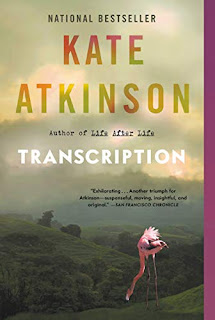
Transcription by Kate Atkinson **** (of 4)

Image
Juliet Armstrong, orphaned at the age of 17 just as Hitler's Germany is rolling across Europe, is scooped up by MI5. Her job is to serve as a typist, a role, of course, only a girl can fill. MI5 occupies two adjoining rooms in a small apartment complex in London. In one, Godfried Toby, an MI5 agent meets British citizens sympathetic, and perhaps outright allies, of the Third Reich. Listening devices are implanted in the walls and voices are recorded  in the adjacent apartment for Juliet to transcribe.  With time Juliet is asked to infiltrate the Fifth Column of British fascists under disguise and with additional time, actually five years after the war ends, Juliet is still enmeshed in spy work, only now ferrying eastern bloc scientists to the west and plying communist sympathizers with false information. Or maybe it is top secret information. Or maybe her handlers were always communist sympathizers. Or maybe Godfried Toby works for no one. Or anyone.  Being employed ...

The Lost Girls of Paris by Pam Jenoff **** (of 4)

Image
In June 1940 Winston Churchill ordered the creation of Special Operations Executive (SOE) for the purpose of sabotaging Nazi operations in occupied portions of France. Among SOE's operatives were Britain's first women in combat. The Lost Girls of Paris  describes the wartime lives of some of these women from their first days as young recruits, through their training, and finally to their secret missions in occupied France. Violette Szabo ,  re-created in  The Lost Girls of Paris  as Marie,  was a British citizen, who as a single mother of a toddler, agreed to parachute into France. Violette Szabo recovering from an ankle injury suffered during parachute training, 1944.  Marie, like Violette, operated a secret radio transmitter under the noses of the Nazis and assisted in blowing up a bridge that would have been vital to German forces responding to the imminent D-Day invasion. What Pam Jenoff does so well is capture the danger, tension, isolation, br...

Old Baggage by Lissa Evans *** (of 4)

Image
Matilde Simpkin is a larger-than-life veteran of England's militant suffragette movement: wise-cracking, verbally combative, and still committed to the rights of women. By 1928, however, women's right to vote is wending its way through Parliament and now middle-aged, Miss Simpkin's retellings of the armed battles with authorities play to bored audiences. A chance encounter with a former militant who in the waning years of the 1920s has taken up with proto-Fascists in the guise of training England's youth to respect order and authority ignites a blaze in Simpkin. In response, she organizes girls and young women into a club called The Amazons, teaching them athletics, hiking, fire-making, throwing, debating, map-reading, and well generally all of the things that girls were forbidden to partake of during the long reign of Queen Victoria. You can see the competition between the two groups in the offing with the underlying (and still wholly relevant) question of how gir...

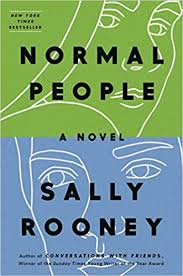
Normal People by Sally Rooney **** (of 4)

Image
In the small town of Carricklea, Ireland, Connell is the lone high school son of a single mom, Lorraine. Lorraine cleans house for Marianne's upper-crust, and as we are going to discover, dysfunctional family. Marianne and Connell are high school classmates, best friends, and so intellectual that their relationships with their high school classmates are tenuous. They are also on-again, off-again lovers and sexual partners swimming their way upstream against the currents of peer pressure, economic class distinctions -- real, imagined, and magnified in British society -- damaged childhoods, impending adulthood, and university attendance in Dublin. Admittedly, my plot and character descriptions sound mundane, but Rooney's development of Connell's and Marianne's relationships to one another and to maturation is so microscopically accurate that their every failure is a painful reminder of our own, and their successes generate unbridled celebration. Normal People  is S...

Professor Chandra Follows His Bliss by Rajeev Balasubramanyam **** (of 5)

Image
Professor Chandra was born in India and almost lived up to his parent's expectations for success. Now, approaching his 70th birthday he is a distinguished, and hilariously pompous, professor of economics at Cambridge University. This might even be the year he wins a Nobel in economics so he practices his nonchalance and indifference in preparation for meeting the King of Sweden. Not only does Professor Chandra fail to win again this year, but now that he has been run over by a student on a bicycle while he absentmindedly crossed the street without looking, he has time to recognize that one daughter stopped speaking with him two years ago, another daughter is not going to college (a blasphemy!), and his son has moved to Hong Kong and barely has time to call. Not that Chandra has really mastered his cell phone, anyway. On a visit to his ex-wife and her husband in Colorado, Professor Chandra is persuaded, rather forcefully, to attend the Esalen Institute in California setting u...

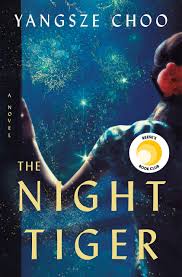
The Night Tiger by Yansze Choo *** (of 4)

Image
In 1931, in the British colony of Malaya, an aging British physician asks Ren, his 11-year-old houseboy to fulfill his dying wish. Find his missing finger within 49 days of his death and bury it with the rest of his body. The doctor dies and Ren begins his search, only the finger, blackened with age and preserved in a glass vial in a rural Malayan hospital is desired by several people at once. The finger might or might not contain supernatural powers, not so far-fetched in 1931, in Asia, where superstitions seem as reliable as modern science for explaining random acts of life. Night tigers attack night wanderers without warning. Philanderers and adulterers, as if deserving of punishment, are struck down by mysterious illnesses. Fortune and misfortune fall upon native Malayans and British ex-pats whose lives intertwine in hospitals, rubber plantations, storefronts, dance halls, trains, and secret rendezvous spots. While the voices of characters don't feel distinct, the characters...

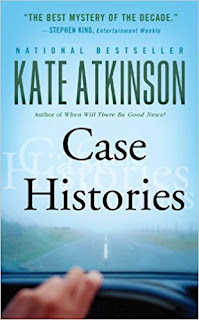
Case Histories by Kate Atkinson *** (of 4)

Image
The first in a mystery series for detective Jackson Brodie. Kate Atkinson's account of a series of women done criminally wrong is delivered with such tartness you can't help but snigger all the way through. Take for example, Sylvia, an ugly duckling of an adolescent, whose mother rationalizes Sylvia's personal conversations with God this way. "And at least conversations with God were free, whereas the upkeep of a pony would have cost a fortune." Or this example. An unsympathetic physician visited by an overweight Theo, a client of Jackson Brodie's, describes his GP as, "a young woman with a very short haircut and a gym bag thrown carelessly in the corner of the doctor's office." The GP calls Theo obese condemning him, "to skim milk and chaff." Theo thinks of himself as a rotund Santa Claus.  Even descriptions of children who disappear and unfortunate souls whose throats are unceremoniously slit come off rather jauntily. The action ...

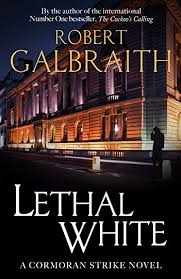
Lethal White by Robert Galbraith *** (of 4)

Image
The fourth in the series of detective stories written for private investigator, Cormoran Strike and his young, intelligent, appealing assistant, Robin Ellacott. Just in case you are not yet aware, Robert Galbraith is the pseudonym for J.K. Rowling of Harry Potter fame. There are too many plots braided through this omnibus of a novel to summarize -- murder, blackmail, greed, love, jealousy, psychosis, tenderness, and rage. Only a writer with the capacity of Galbraith/Rowling could hold it all together, create a page turner, and concurrently press the reader to move beyond the question of whodunnit. Front and center in Lethal White  Galbraith raises questions about the enduring straight jacket of class in Great Britain. Standing upon shaky pedestals are a moneyed gentry of politicians, estate owners, and racehorse enthusiasts. Galbraith doesn't hesitate to lean on those pedestals until the bloviating statues of upper crust England come toppling over. Meanwhile, Galbraith points ou...