Posts

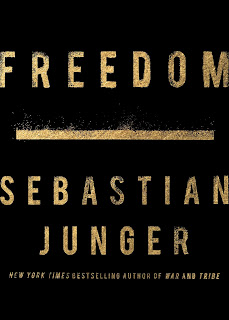
Freedom by Sebastian Junger ** (of 4) and last post here
Image
This is my last post at this website. To continue to receive very occasional posts about books and breads, please sign up at ericpallant.com on the blogs page.  Junger takes a walk along the railroad tracks from somewhere in eastern Pennsylvania to somewhere in the western part of the state, near Ohio. It is illegal to hike, camp, or otherwise mess with American railroads so Junger treats the adventure a lot like a war story, for which he is already famous from previous writings. Townies in rural PA are mostly threatening, gun toting, and unpredictable. Railroad cops could be looking out from anywhere. So long as he remains unseen, however, his friends, his loyal dog, and he are free in a very Thoreau-vian sense . Four men with nothing more than what they can carry evade a lot of people, cook over secretive open fires, drink from passing streams, hide at night in the brush, and cope with offensive rains. Between wonderfully evocative pastoral descriptions of forests and loomi...

TIME TO MOVE

Image
  I am consolidating my Blog and a new Website If you want to continue to receive occasional email posts of book and bread reviews, you'll have to travel to  https://www.ericpallant.com/blog . On the right side panel, you'll need to fill in your name and email. It's a two-step process. You'll receive an automated email asking if you're serious about this and have to reply YES before you start receiving new notifications of posts. Of course, if you already receive too many emails, buzz over to the new website , take a quick look, and then don't sign up. BONUS . On the blog, you'll see a review for one of my favorite books of the year, Deacon King Kong by James McBride.

Sourdough Ciabatta

Image
 It is such a simple looking bread: ciabatta, the Italian word for slipper. Maurizio Leo's recipe in The Perfect Loaf  contains ciabatta's signature addition of olive oil in the dough, but it is also made with freshly milled Khorasan, aka Kamut, flour. Khorasan is a region of Iran; the flour is is golden in color. The bread when it emerges from the oven has a thin, crackly crust and an open crumb. As toast for the next couple of days (Maurizio's recipe turns out four loaves) the rewarming intensifies its slightly nutty flavor, its external crunchiness, and internal chewiness. My son Isaac is the King of Sandwich. He thought to slice the ciabatta along its equator, fill it with spicy barbecued, pulled chicken, and top it with homemade cole slaw (Isaac is also a Slaw Master.)

Reconstruction by Eric Foner ***(of 4)

Image
  As part of my ongoing attempt to learn the American history I should have been taught I continue to read histories of Blacks, Indians, women, workers, and immigrants. Among the eras I have heard about, but knew comparatively little is Reconstruction, the period immediately following the end of the Civil War. The simple description is the North won the war. Foner's encyclopedic description of the decades that followed strongly suggest that though the America was reassembled, it was not reunified, and that the battle over emancipation and the rights of Blacks to vote freely and fully participate in the economy of the nation has still not been won. In many ways, the South lost the Civil War, but won its battle for White Supremacy. Witness the 2021 southern legislatures forbidding the teaching of Black History in schools (derogatorily called Critical Race Theory when in reality it should be called American History) and ongoing attempts to limit access for Black voters. I digress, tho...

Plunder by Menachem Kaiser *** (of 4)

Image
  The author's grandfather was the only member of his Polish family to survive the Nazi's death camps. Grandpa died before the author was born, but according to the author's father, after the war ended, the grandfather spent 20 unsuccessful years tilting against Polish and German bureaucracies in an attempt to reclaim his apartment building in Sosniewicz, Poland.  Menachem Kaiser reengages the struggle for restitution in part to see if he can find an attachment to the grandfather he never met. With a jaundiced eye at other so-called Holocaust tourists - Jewish descendants just like himself searching for some abstract kind of connection to lost family or closure - Kaiser learns the building is worth $400 and cannot fathom why his grandfather suffered such anguish to get it back.  What makes the book interesting is Kaiser's musings on the nature of homelands, the meaning of forcible loss of property, and then as he gets closer to potential acquisition of his grandfather...

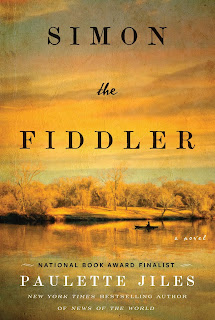
Simon the Fiddler by Paulette Jiles **** (of 4)

Image
  A yarn as wide as the Texas landscape. It is 1864 and Simon the Fiddler makes a living the best he can by playing jigs, reels, waltzes and hornpipes. It's not quite as disreputable a profession as being an actor, but a lot of venues include the kinds of saloons and dance halls that the upper classes tend not to frequent. Until the Union Army conscripts him, that is, and he has to play fiddle and soldier for a year. At the war's so-called conclusion - it doesn't so much end as degenerate into a kind of barely controlled chaos as Union forces occupy the state of Texas and barely maintain order - Simon teams up with three additional veterans and together they escape their army duties to play music, barely make ends meet, and have adventures along the Gulf Coast and the Mexican border. Paulette Jiles evokes of the landscape and era of post Civil War Texas with such acuity you can hear individual birds sing, grasshoppers hum, and feel the heat of an unrelenting sun. The ...

The Bomber Mafia by Malcolm Gladwell **** (of 4)

Image
 In this tight little book (originally a 6-hour podcast) Gladwell lays out the question of whether warfare is best fought to minimize collateral damage to civilians and fundamental infrastructure, or, on the other hand, ended most expediently by maximizing an opponent's losses with the intention of bringing about a speedy end to the conflict.  In World War I, airplanes were used for the first time, but mostly to fight other airplanes. As WW II approached, an elite group of pilots wondered if the advent of precision bombing could not only alter the outcome of the war, but transform warfare altogether. In theory the Norden bombsight, an analog computer, contained enough calculations and adjustables that a bomber could finally land a bomb on a strategic target like a fuel depot, transport junction, or a factory that made spare parts for the enemy's planes. Precision bombing could, in theory, end the enemy's ability to fight. In practice, however, the bombsight was less than su...

Rye Sourdough English Muffins, with recipe

Image
  Most often, when I make bread without a recipe, I assemble ingredients entirely by the look and feel of the dough and however the spirit moves me. Something told me in advance that English muffins leavened with a rye sourdough starter might be good so I measured as went along. The recipe can be found here . Please send me photos and suggestions, if you decide to give it a try. Frying the muffins in a buttered, cast iron skillet made both sides crisp, crackly, and already slightly buttery. The muffins are much heavier than the aerated versions produced by Thomas's, but the sweet rye, creaminess imparted by buttermilk-enriched dough, and the sour notes unique to rye starters combined to make a perfect base for everything from a schmear of butter to more complicated sandwiches with multiple toppings. They could also serve as buns for vegetables or meat coming from a barbecue. One side. And the other.

Cold Millions by Jess Walter **** (of 4)

Image
Jess Walter supplies a fine amalgamation of fiction and history, melding historical figures, most notably Elizabeth Gurley Flynn, a fiery rebel who fought for the rights of working class men and women (and founding member of the ACLU) with a pair of fictitious Irish brothers searching for work in Spokane, Washington at the start of the 20th century. Lumber and mining barons are bulldozing the earth, earning and spending millions of dollars. Hobos, tramps, Native Americans are hired and fired at will, surviving on pennies a day, eating pilfered chickens, living in unwashed clothes, and sleeping in flophouses or open fields. Organized labor has taken its battle from wars in mining and timber camps across the west and heads to Spokane for a standoff with heartless employers. The Wobblies (I.W.W.) are enjoined by anarchists, communists, and socialists, but have their heads cracked by police, vigilantes, Pinkertons, and infiltrators hired by politicians and executives intent upon saving ord...

Sourdough naan with ramps and cumin

Image
Every spring when ramps arrive in the local woods and I receive bunches in my CSA, I make pesto, and also some kind of ramp pancakes. This year I chopped my ramps, mixed them with whole wheat sourdough starter, a cup of buttermilk, and crushed cumin seeds. I made a dozen and a half: a perfect accompaniment to a spicy pot of curried red lentil dal.  

The Sound of Baked Sourdough Bread

Image
 Last week I made Maurizio Leo's Rustic Italian Sourdough . The bread has flour from durum wheat in it. Durum wheat is typically used to make pasta, but its golden yellow color imparts rich, slightly sweet flavor to bread, which I love. Most people know that fresh homemade bread smells incredible and tastes much better than anything that comes from a store. When it is still warm it feels sensuous, and for most bread lovers, even the sight of fresh bread makes our mouths water. That covers four senses: sight, taste, smell, and feel. But finished bread sounds good, too. When it is done, a tap on its base will resonate like a drum, but pay close attention to this clip. When a loaf comes from the oven, it crackles with goodness.

The Great Mortality by John Kelley *** (of 4)

Image
It started in China in the first half of the 14th century and by 1348, fleas riding rats (and maybe marmots) carried a pandemic across Asia and Europe. Between one-third and one-half of all the people on those two continents died.  Europeans of the Middle Ages were not famous for their comprehension of science, their record keeping, nor their cleanliness. Yet, death by plague was so ravishing that it was the preeminent event of a century, so clear in its approach and consequences, an accurate timestamp can be placed on a map for the date of its arrival in city after city. Within days or weeks after making its entrance, the plague bacterium, Yersinius pestis , eradicated nearly half of everyone it encountered. Pause and think about the impact of a mass and instantaneous die-off of that magnitude and you can understand why American defense specialists used the plague as a model for the aftereffects of nuclear war. Like today's COVID-19 pandemic, anticipation of the plague's arriv...

Naturally Leavened Rye and Oat Bread - Breadtopia

Image
Rye flour has different chemistry and a whole lot less gluten than wheat flour so it is difficult to get it either to rise or to cook through. This Rye and Oat bread made with freshly milled rye flour and oat flour milled from oat groats was never kneaded. I mixed the flour with water, honey, salt, and my rye starter according to the Breadtopia formula , added some oat groats I cracked in my new mortar and pestle and then baked a lot longer than the recipe suggested: ninety minutes in a covered Pullman pan. After coming from the oven, rye breads need to continue to release moisture or their innards will be gummy and I let this one sit untouched for 36 hours and it was still super moist in the interior. The upside is that rye bread is generally very sour, dense enough to cut into very thin slices, sweet like molasses,  resists staling for more than a week, and when toasted produces a crackly exterior, soft interior, and deepened sweetness that pairs with any topping of cheese or can...

Burn the Place by Iliana Regan **** (of 4)

Image
 Place this book in the category of Who-like cries ( Horton Hears a Who,  Dr. Seuss) from fly-over country: "We are here. We are here." Like Tara Westover's Educated  and J.D. Vance's Hillbilly Elegy , Regan's Burn the Place  is a coming of age story for an alcoholic child of a dysfunctional family. And like Westover and Vance, she succeeds against odds that seem unfairly stacked against her: untreated mental health issues, growing up lesbian (and perhaps trans) in religious, rural Indiana, discordant parents, and excessive self-medication with drugs, alcohol, and sex.  Regan's recounting of childhood, puberty, and early adulthood are presented with bare-faced honesty and without polish. Burn the Place  is not crafted as a morality tale like other books of the genre. Rather, pluck and luck seem to be Regan's saving graces. She might just have easily ended up dead in a drunken car crash. Instead of dying, she hones a life based on an intrinsic understanding...

Dark Mirror by Barton Gellman *** (of 4)

Image
A super provocative book, written by a Pulitzer Prize winning journalist, that is a surprisingly poor read. Gellman was one of three reporters to receive the information Edward Snowden stole from the National Security Administration and dumped in their laps on his way out of the United States. To explain their significance, Gellman describes how much  digital surveillance the United States is capable of. By extension it is evident that rogue hackers and other countries around the world (Russia, North Korea, Iran, Israel, China) are waging vicious and secret attacks upon one another's computer systems. So if you begin with the premise that every computer system, and hence every office, school, home, military, weapons system, electrical grid, medical facility, communications network, transportation system, etc., is vulnerable, you can recognize how high the stakes are. Gellman than explains that spycraft in the digital age is simply updated, and highly technological, cloning of old f...

Cold Mourning by Brenda Chapman ** (of 4)

Image
 The newbie in the Ottawa police force for investigating cold case is Kala Stonechild, a First Nations policewoman recently transferred from the far north of Canada. Learning more about her troubled background, and by extension, Canada's injustices toward its indigenous people, is the draw for the mystery, but it fails to deliver. The mystery of who killed an unlikeable business tycoon includes only ordinary suspects: shady office partners homing in on big payoffs and spurned family members.  Stonechild is smart and brooding, but not much deeper than that and you know from the beginning she is the one person likely to break open the case. To an American reader the one (unintentionally) funny part of the book is the supposed hazing Stonechild receives from the boys club of detectives she is forced to join. Because they are all Canadian, to my ears, they are all incredibly pleasant. The worst offenses directed at her  consist of failing to apologize if they are interrupted ...

The Undoing Project by Michael Lewis *** (of 4)

Image
Amos Tversky and Danny Kahnemann, were a pair of exceptionally brilliant Israeli thinkers, who forged a friendship and academic partnership that led to the invention of behavioral economics and a Nobel Prize. Before the pair started questioning, and then testing, centuries-old dogma about economic behavior, the fundamental assumption by economists was that all humans acted out of self interest. People maximized gain, prioritized happiness, avoided pain, weighed benefits against costs, and made decisions with the best odds for the most advantage. Only, Tversky and Kahneman when they gave people a variety of choices whose outcomes were mathematically proven to have a better and worse outcome, discovered that a surprising number of people made the wrong decision. Not just ordinary people made mistakes; even statisticians with PhDs who should have known better could be induced to select a path that was demonstrably worse than a clearly correct answer. For example, a terminally ill patient ...

The Thursday Murder Club by Richard Osman *** (of 4)

Image
  Richard Osman gets credit for inventing a new detective, in this case, a crew of detectives. In addition to a pair of peripheral police officers in a small town outside London, the primary investigators into a series of murders are four residents of a senior living center. They suffer from mobility issues. They pay undue attention to who sits with whom in the dining room. They drink wine while pretending to work on jigsaw puzzles and they tell stories in the long-winded, gossipy way of old people. But they haven't lost their mental acuity. At least not yet. The Thursday Murder Club is comprised of two widowers (Ron, whose son at least still visits from time to time, and Ibrahim), a widow (Joyce, who maintains a keen eye for newly arrived single men) and Elisabeth, whose husband is rapidly disappearing into the ravages of dementia. They gather in the jigsaw room - before Zumba - every Thursday to try to solve old cases left in files by one of their founding members, Penny, a forme...

Sourdough Bialys and Sourdough Scallion Pancakes - BREADTOPIA

Image
  Eric Rusch, patriarch of Breadtopia.com , as best I can tell was into baking for a long time, but until relatively recently mostly they guy to turn to if you wanted to purchase gear and supplies for making bread. The on-line store is stocked with nearly everything a bread baker could wish for. Over the years, Breadtopia has added on-line tutorials, videos, blogs, discussion forums, and an occasional newsletter with new bread recipes. Many of the recipes extend to the global repertoire of breads, and in contrast to Maurizio Leo's precise formulae (see The Perfect Loaf ), Rusch's recipes leave more space for interpretation, trial, and error. But his recipes are nonetheless fantastic. These sourdough bialys were light without being starchy, soft without being doughy, and firm without becoming too crisp. Most of all, the caramelized onion topping, doused with olive oil and sprinkled with poppy seeds were so beguilingly sweet I had to double check that no sugar was included at an...

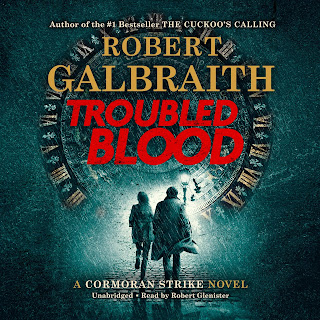
Troubled Blood by J.K. Rowling (Robert Galbraith) *** (of 4)

Image
  Fifth in the JK Rowling series of crime novels in which private detective Cormoran Strike and now-profesional-partner Robin Ellacott get paid to investigate crimes. Naturally, they receive a lot of requests to track down philandering husbands and business partners suspected of skimming the books, but also once per book they also have to cope with someone truly despicable and dangerous. Troubled Blood  is a request from the daughter of a mother that went missing decades ago. At the time of the incident the disappearance was pinned on a pathological serial killer, but the evidence was shaky and the investigating policeman was losing his mind. Rowling is a master of multiple storylines: we find ourselves tied up in more than a search for a presumed killer. We want to know whether Cormoran and Robin can keep their relationship strictly professional and how each will grow following losses in their personal lives. It matters how the two of them relate to their parents, struggling ...