Posts

Caste by Isabel Wilkerson **** (of 4)
Image
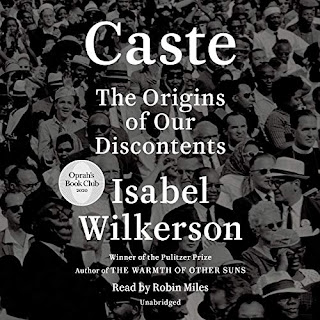
  In 1932, when Nazi planners were devising a plan that would lead to the marginalization, denigration, disenfranchisement, and eventual elimination of its Jewish citizens, they modeled their efforts on how America marked its black citizens in such a way that they could not be full members of American society. Nearly 70 years after slavery was outlawed, Black Americans could not attend white schools, eat in white restaurants, drink from white water fountains, swim in white pools, live in white neighborhoods, walk on a sidewalk if a white was approaching, or speak back to a white person in any way other than deferential. Failure to adhere to the rules of American white superiority could result in summary execution by mobs of self-appointed upholders of white law. More than 4,000 blacks were lynched. American segregation was the perfect model for Nazism and somehow I never learned that in school. What Caste  makes clear is that race, or more accurately, skin color was an arbitra...

A Gentleman in Moscow **** (of 4)

Image
 " Either you master your circumstances, or your circumstances will master you. " Soon after the Russian Revolution in 1917, Bolshevik authorities convicted the former aristocrat, Count Alexander Rostov, of crimes against the newly formed government. He wrote a poem critical of the authorities. Instead of martyring Rostov, they ascribed a punishment fit to a Russian, internal exile. Rostov was put under house arrest in Moscow's finest hotel, the Metropol .  The Piazza, one of the Metropol's dining rooms. Rostov remained inside for the next 32 years, but throughout his stay maintained unrivaled equanimity, erect posture, impeccable manners, exquisite taste in fine wines and elegant cuisine, and erudite allusions to the world's great literatures and philosophies. In short, while Stalinism and three decades of the Russian revolution played before him from the 1920s through the 1950s, Count Rostov's triumph was his ability to master his circumstances, providing a ...

The Missing American by Kwei Quartey ** (of 4)

Image
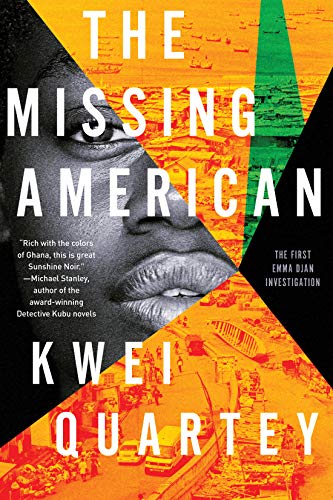
On the up side, The Missing American  captures Accra, Ghana in 2019. The vitality of a city bursting with a swelling population, new buildings begin constructed so quickly that potholed, unpaved roads don't match their shiny exteriors, incapacitating traffic, and street hawkers selling a WalMart of plenty. Also, the inside look at cybercrime is illuminating. We all remember the days when Nigerian princes emailed us asking for money; now, sakawa  boys of Ghana have advanced their digital scams with great sophistication and it's fun to learn how they do it. After extracting money from susceptible patrons in the global north they using their profits to pay fetish priests to imbue them with additional money making powers, to corrupt everyone from local police to major politicians, and naturally to purchase really flashy cars. On the down side, Emma Djian, Ghana's 26-year-old, virginal (yes, that seems important that the author let us know), crime fighter whose only personal int...

Surrender White People by D.L. Hughley *** (of 4)

Image
It is interesting that so many books on the market about white supremacy and racism were published long before the murder of George Floyd finally got white people to stop and pay attention. Surrender, White People!  was published post-Floyd, but written before, just one more confirmation that a book about the mistreatment of Black Americans by white Americans would continue to be prescient. Hughley's approach to trying to get white people to understand is to describe life for Blacks as if it were funny. The book is short, but encyclopedic in its coverage, covering topics that everyone should know. Blacks have been denied access to fair housing for generations. Health care and food access for Blacks is of poorer quality than it is for whites. Schools for Black children are more crowded and less well funded. Air pollution and leaded water systems are more prevalent in Black neighborhoods. Jobs, salaries, incarceration rates, arrests and so forth generate worse outcomes for Blacks tha...

The Enemy of All Mankind by Steven Johnson ** (of 4)

Image
Most book reviewers loved Enemy , but I think it is terribly overrated. In the 17th century, Henry Every, a British pirate, stole a fast-sailing ship from the Spanish coast, sailed it to India, and attacked an exceptionally well-endowed vessel belonging to one of India's wealthiest Mughals. His crew, after a year at sea, upon discovering women on board, did some evil things to them. Johnson does a decent job of laying context. The distinction between being a pirate and a British privateer was rather fuzzy so in Johnson's telling, acting as a pirate might not have been such a bad job, after all, especially at a time when the British government was capturing young men to "impress" them into their Navy. The British Navy, too, was in the business of protecting Great Britain's colonies, which, if you look at them with modern eyes, were nothing more than piratical extractions of resources from stationary targets.  But Johnson expends way too many words inflating the das...

Mythos by Stephen Fry *** (of 4)

Image
What makes the Greek gods so endearing is their thoroughly human characteristics. They love, honor, envy, spite, trick, support, double cross, respect, forget, bumble, succeed, fail, muddle, regret, and persevere, undergoing many of these practices and emotions in a lifetime and in a hot second.  Stephen Fry brings the gods to life, the ancient Greeks who first introduced us to them, and the enduring legacy of Greek mythology. Accompanying each lively story, in myriad footnotes, he explains the relationship between the Greek gods and the hundreds of words and professions that continue to exist in Western civilization and the English language to this day.  Mythos  also yanks us from our egocentrism, reminding us that our woes and exaltations, small and large, personal and national, are not so unique after all. Being human is difficult. The ancient Greeks already knew that.

The Unlikely Disciple by Kevin Roose *** (of 4)

Image
It was a great idea (especially in 2010), pulled off with panache. The author, Kevin Roose, took a leave of absence from Brown University in the second semester of his freshman year. Instead of studying abroad with other Americans in Madrid or Paris, Roose enrolled at Liberty University, America's flagship school for evangelicals, thus moving from one of the most liberal to one of the most conservative universities in the United States. Most of what Roose describes would not be a surprise to anyone following Jerry Falwell's political agenda. If you are not so familiar, then this book is a good introduction to a university that insists that no liberal views are permitted on its campus. Students "learn" that evolution never happened and the earth is only 6,000 years old. Abortion is murder. All homosexuals are faggots. Women should marry early, support their husbands, and bear many children. Prayer is infallible. Muslims are infidels. Also, not very surprising, Roose di...