Posts

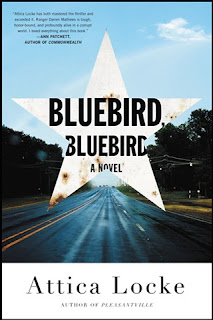
Bluebird, Bluebird by Attica Locke *** (of 4)
Image
Highway 59 bisects the United States down its middle. As it dives through East Texas the division between white and black America is a long fuse waiting for a spark. Attica Locke describes what happens in a small waystop along the highway: in one end of town a poor black and elderly Geneva Sweet serves tired, hot, mostly black customers, and on the other end, a bar serves alcohol to tattooed members of the Aryan Brotherhood. When a black man is murdered before a white woman is murdered -- inverting the expected sequence of events -- a black officer in the esteemed Texas Rangers, Darren Matthews, is sent to investigate. Opening a murder mystery with a reminder that whenever a white woman in the south is threatened, a black man is selected to pay the price is a reminder that pervades the book. On its heels is the important, and too often overlooked point, that for every black man unjustly imprisoned by a southern white jury there is a black person victimized by crime that remains ...
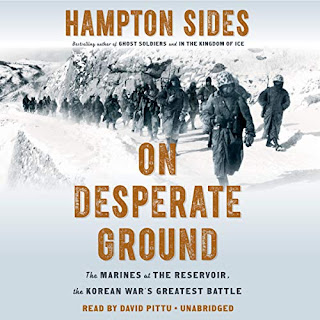
On Desperate Ground by Hampton Sides **** (of 4)

Image
In 1950, the Cold War between communists in the Soviet Union and communist-fearing Americans led by the likes of Senator Joseph McCarthy was feverish. President Truman -- as all Presidents must -- was attending to domestic crises when North Korean communists invaded the southern half of the country. General Douglas MacArthur, a man of Trumpian self-assurance, insisted the communists could be demolished in the background while MacArthur posed for press photos in the foreground. Edward Almond, Commander of the U.S. Marine X Corps was a MacArthur sycophant who directed the marines to push the North Koreans out of the south. Mission complete, he ordered the marines to continue their march to the Yalu River on the Chinese border. General MacArthur posing during the invasion of Inchon On Desperate Ground  manages to paint a picture that remains in focus when seen from spy sattelite and when magnified to individual marines trapped along the Chosin Reservoir. X Corps was surrounded...

The Color of Love by Marra B. Gad *** (of 4)

Image
Marra B. Gad was born of a Jewish mother and African American father and adopted at birth by a Reform Jewish family in Chicago. Her new family loved her to pieces and she was raised in Reform Jewish tradition, which is to say Hebrew School, camp, Bat Mitzvah, and an ample supply of desserts. Only Marra's skin is black and many aunts, uncles, and cousins treated her with thinly disguised, racist contempt. Most blatant of all was Marra's great aunt Nette whose love and approval Marra coveted. Nette finally says aloud what has been obvious for decades, "Nothing is worse than being black." And yet in a triumph of human spirit and fundamental teachings of Judaism to provide succor to the unwell and aging, Marra serves as Nette's primary care giver as Nette succumbs to Alzheimer's. The Color of Love  reminds us that we are all made of multiple pieces -- religion, age, temperament, weight, nationality, sex, gender -- and that skin color, like the size of our e...

Experimental and Traditional Sourdoughs For Annual Marty Week

Image
10-grain breads. Every year, Sue's brother Marty flies in from California for a holiday season of serious cooking. We collaborate on some baked things, but mostly I try to keep loaves of bread around to handle leftovers. This year Marty made prime rib, sous vide salmon, elk roast, Danish smorrebrod, and affiliated dishes too numerous to list.  I've begun experimenting with recycled breads and have had great success using old ryes. I break a stale bread into chunks and add water to soften. In the two loaves (above) I reused a Danish rye that was insufficiently cooked the first time round so it wasn't a great eat. The original loaf contained flax seeds, pumpkin seeds, sunflower seeds, wheat and rye berries. To the mash I also added chopped walnuts, oats, and corn meal. If you count the spelt flour in the dough, the final loaf had 10 grains, a moist interior, crisp crust, and enough deliciousness that the first loaf was gone by afternoon and the second disappeared th...

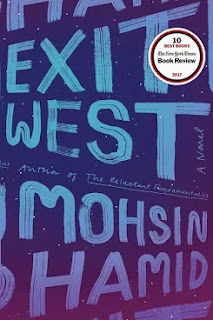
Exit West by Mohsin Hamid **** (of 4)

Image
Saeed and Nadia live in an unnamed, but all too familiar, Middle Eastern city where government forces are slowly losing the battle to Islamic militants. The young couple meet in college, before it closes, when  Saeed finally finds the courage to ask Nadia out for coffee on a Friday. When Nadia asks him why he isn't going to be praying, Saeed has to stumble for an answer. Later, when Saeed asks Nadia why she remains fully covered in traditional robes even though she is not religious, Nadia replies, "So men don't fuck with me." What follows is a courtship interspersed with car bombings, government reprisals in the form of long-distance shelling and air raids, and neighborhood by neighborhood success of young combatants drunk on power as the government slowly loses control of its country. Escape from the city is condensed: an enormous sum of money is handed to a trafficker who might steal the money or actually provide safe passage. In Exit West , transport is acco...

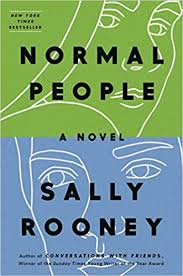
Normal People by Sally Rooney **** (of 4)

Image
In the small town of Carricklea, Ireland, Connell is the lone high school son of a single mom, Lorraine. Lorraine cleans house for Marianne's upper-crust, and as we are going to discover, dysfunctional family. Marianne and Connell are high school classmates, best friends, and so intellectual that their relationships with their high school classmates are tenuous. They are also on-again, off-again lovers and sexual partners swimming their way upstream against the currents of peer pressure, economic class distinctions -- real, imagined, and magnified in British society -- damaged childhoods, impending adulthood, and university attendance in Dublin. Admittedly, my plot and character descriptions sound mundane, but Rooney's development of Connell's and Marianne's relationships to one another and to maturation is so microscopically accurate that their every failure is a painful reminder of our own, and their successes generate unbridled celebration. Normal People  is S...

Sourdough Rye - Danish Style

Image
Rye breads are tricky because they have almost no gluten. To compensate many rye bread recipes contain only a small amount of rye flour, the bulk being given over to wheat flour whose gluten allows for an ample rise and light crumb. When the rye content of a recipe increases a baker can knead for an exceptionally long time to encourage what little gluten there is to bind together so the bread will rise, or the recipe calls upon yeast to supplement a sourdough culture. Commercial yeast can lift nearly anything. Danes, like citizens of other northern European countries too cold to grow much wheat, consume a lot of rye bread, much of it made with 100% rye flour. This Danish rye made with soaked flax seeds and a tablespoon of barley malt syrup was leavened using only a rye sourdough starter. The dough was not kneaded, but simply allowed to ferment for eight hours at 67 degrees. It doubled in volume and the result was a richly flavored, slightly sour, malted, full-bodied rye bread....