Posts

Rough Magic by Lara Prior Palmer ***(of 4)

Image
Lara Prior Palmer was not just the first woman to win the cross-Mongolia horse race, she was also the youngest, capturing first place at the age of 18. It seems anyone can enter, and on a whim, without training, but a general knowledge of horses, Prior Palmer entered the race as a better post-high school adventure than entering college. Racers traverse 1,000 km of Mongolian steppe by riding one semi-wild pony after another. Chafing, blisters, sunburn, falls, diarrhea, drunk Mongolians, injuries, and exhaustion overtake more than half the competitors every year. And yet, as they say, she persisted, enduring all those calamities.  What emerges in this memoir is a woman who can communicate with horses in ways I did not know were possible, probably a compensation for her relative inability to interact with people. Prior Palmer's internal dialogue appears on paper with the wisdom of a woman double her age and craft of a writer with four times her experience. Her ability t...

Professor Chandra Follows His Bliss by Rajeev Balasubramanyam **** (of 5)

Image
Professor Chandra was born in India and almost lived up to his parent's expectations for success. Now, approaching his 70th birthday he is a distinguished, and hilariously pompous, professor of economics at Cambridge University. This might even be the year he wins a Nobel in economics so he practices his nonchalance and indifference in preparation for meeting the King of Sweden. Not only does Professor Chandra fail to win again this year, but now that he has been run over by a student on a bicycle while he absentmindedly crossed the street without looking, he has time to recognize that one daughter stopped speaking with him two years ago, another daughter is not going to college (a blasphemy!), and his son has moved to Hong Kong and barely has time to call. Not that Chandra has really mastered his cell phone, anyway. On a visit to his ex-wife and her husband in Colorado, Professor Chandra is persuaded, rather forcefully, to attend the Esalen Institute in California setting u...

Sheets by Brenna Thummler *** (of 4)

Image
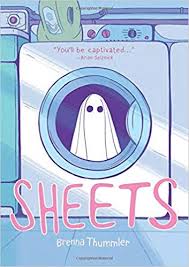
Sheets  tells a traditional story. A recently motherless girl just entering high school must survive the torments of adolescence, a grieving and largely absentee father, and caring for a younger brother. As if this were not enough to depress the spirit of young Marjorie Glatt she must also single handedly run her mother's former laundry business. Think Cinderella. There is, of course, an evil, no-goodnik, bad guy deviously trying to run her out of business so he can acquire the property to raise in its place a multi-story, money-grabbing, yoga spa. Only now appreciate the strength of a graphic novel whose drawings symbiotically elevate the story. Add in a ghost not quite ready to leave the earth of the living who might just come to the rescue of a laundry about to run its last load. If only Marjorie can get over her fear of ghosts.

The Tourist by Olen Steinhauer ** (of 4)

Image
Milo Weaver was a CIA employee, commissioned as a "Tourist" responding to orders to track and kill enemy agents. Weaver manages to kill bad guys efficiently, without explanation or rationale from his superiors. The so-called Bureau of Tourism within the CIA, as well as its mission, is so secretive that its "Travel Agents" apparently work without oversight and Tourists act without portfolios. As much as Milo had hoped to retire from Tourism, and is now married and father of an 8-year-old daughter, no Tourist ever leaves his past behind. In short order, Milo finds himself ensnared in deadly conflicts with spies and Tourists from France, Russia, the United Nations, and though he cannot be certain, his bosses within the CIA. Olen Steinhauer is hoping his readers are completely entranced by a quick moving plot with hairpin turns and will forgive the fact that his writing is all rather meme-ish, especially with regard to his portrayal of female characters. Though n...

Tasting Sourdough for the First Time

Image
This fall I am teaching a class called, You Are What You Eat , for incoming Freshmen.  For our first meeting I baked a large sourdough bread for them to taste. Their first assignment was to write a bread review. Did they like the crust? Was the flavor appealing? How did the interior appear to them? Ten of the fifteen students didn't really like the bread. The crumb had too many holes. The flour on the crust really annoyed them. So did the crust, which required too much work to chew and was not the color they were accustomed to. Mostly, they complained about the sour flavor, which several reported did not taste like "normal" bread. A few like it adding the compliment that it tasted like what you could get in a restaurant and one thought it would make a decent Peanut Butter and Jelly sandwich. I think I'm learning something about what incoming Freshmen consider "normal" food.

The 100 Most Jewish Foods edited by Alana Newhouse **** (of 4)

Image
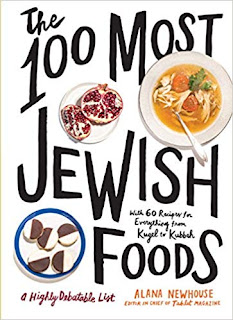
Admittedly, any book with an image of black and white cookies on its cover is going to grab my interest. This book about Jewish foods traditional to Ashkenazim of Eastern Europe, early 20th century immigrants to New York City, North African Sephardim, and foods the editor suggests should be traditional are included. Each item receives about a page of description and 60 of the 100 are accompanied by recipes. As both the subtitle and introduction make clear, the  100 Most Jewish Foods is highly debatable. Chicken soup, matzoh balls, tsimmes, bagels are all obvious, but every reader can only imagine how many impassioned discussions took place before Entenmann's made the book, but Fruit Cocktail did not. Pickles, lox, brisket, tuna fish, and margarine made the cut, but not Cool Whip or Cel-Ray. And Oy, the arguments that must have ensued over recipes? How many different recipes for chicken soup do you think could be gathered from a roomful of Jewish mothers? Which one to includ...

The Night Tiger by Yansze Choo *** (of 4)

Image
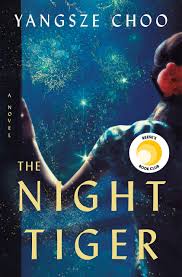
In 1931, in the British colony of Malaya, an aging British physician asks Ren, his 11-year-old houseboy to fulfill his dying wish. Find his missing finger within 49 days of his death and bury it with the rest of his body. The doctor dies and Ren begins his search, only the finger, blackened with age and preserved in a glass vial in a rural Malayan hospital is desired by several people at once. The finger might or might not contain supernatural powers, not so far-fetched in 1931, in Asia, where superstitions seem as reliable as modern science for explaining random acts of life. Night tigers attack night wanderers without warning. Philanderers and adulterers, as if deserving of punishment, are struck down by mysterious illnesses. Fortune and misfortune fall upon native Malayans and British ex-pats whose lives intertwine in hospitals, rubber plantations, storefronts, dance halls, trains, and secret rendezvous spots. While the voices of characters don't feel distinct, the characters...